


Abstract
Recent updates in official U.S. public nutrition messaging show a clear shift in thinking: moving away from treating refined carbohydrates as the “base,” and toward emphasizing high-quality protein and ample fruits and vegetables as the core. This update strongly promotes the “Eat Real Food” concept, encouraging minimally processed, close-to-whole foods as the foundation of daily eating, while limiting ultra-processed foods. This “return to real food” trend is reshaping how people think about healthy diets, and it also offers a meaningful direction for rethinking pet nutrition.
Dogs face many of the same common issues: obesity, metabolic burden, and gut microbiome imbalance. Meanwhile, long-term feeding patterns centered on high-starch formulas such as kibble have made the gap between “label compliance” and “real digestive utilization” increasingly obvious. This article treats AAFCO as the minimum safety baseline, and combines perspectives on ATTD (Apparent Total Tract Digestibility), degree of processing, and functional fibers / prebiotics, while explaining why fresh food can be one diet direction that better matches canine physiology.
1. The Real Food Pyramid: A human dietary paradigm shift as a reference for canine nutrition
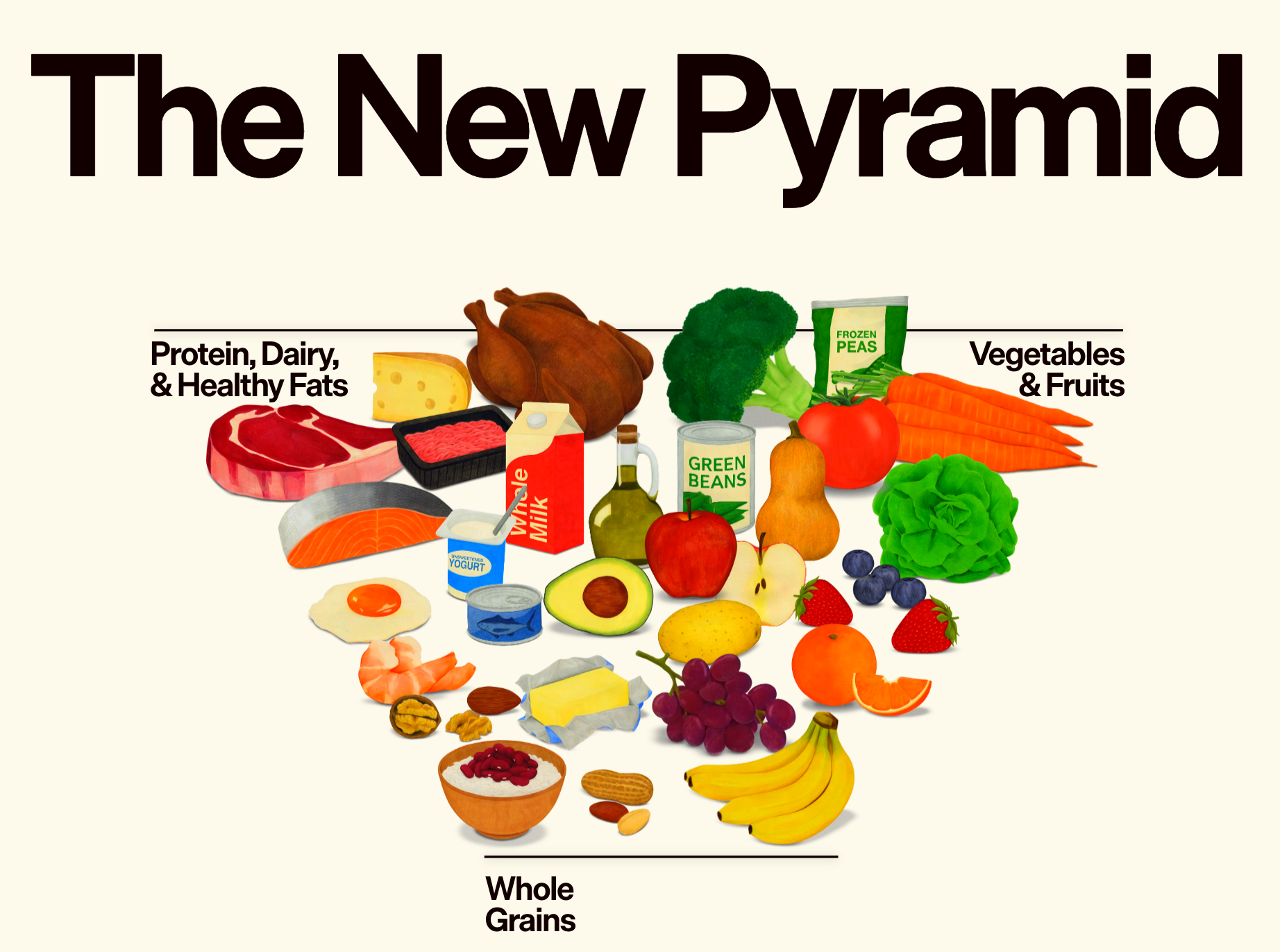
“Eat Real Food” presents dietary priorities using a pyramid: high-quality protein, dairy, and healthy fats as the core, supported by ample fruits and vegetables, with whole grains as a more moderate option. It also emphasizes less processing and fewer additives, and reminds people to limit ultra-processed foods.
The key is not obsessing over a perfectly precise nutrient ratio, but returning to more fundamental questions: Is the source clear? Is the processing excessive? And is this approach sustainable in real life?
In nutrition terms, this shift offers an important reference point: instead of asking what the label says, ask what the body actually absorbs. Moving from “meets requirements” to “is the nutrition truly utilized” is the most critical step when translating the real-food logic into canine nutrition evaluation.
2. How kibble became mainstream—and its structural limitations: from “storage convenience” to the cost of processing load
Kibble was originally designed not to be “closest to canine physiology,” but to solve shelf stability and feeding convenience. The first commercial dog biscuits appeared in the mid-to-late 19th century, marketed for being long-lasting and portable. In the 1950s, kibble truly became industrialized through extrusion—a manufacturing process that relies on high heat + high pressure + a certain starch level to form shape.
Extrusion enabled mass production, controllable costs, and long shelf life. But in essence, it prioritizes human convenience (storage) while sacrificing part of nutritional value (heat processing). By the 1990s, marketing powerfully reinforced the idea that “kibble is the healthiest/only proper way.”

To be precise: kibble is not automatically unhealthy, and it can be nutritionally complete. However, it does have several structural limitations that can make “meeting standards” differ from “being well-digested and well-utilized”:
- Heat processing may affect nutrient availability, such as changes in the usability of certain amino acids after processing.
- Processing can alter starch structures and fermentable substrates (e.g., resistant starch), which may influence gut metabolism pathways and stool quality.
So the point isn’t to reduce kibble into “good vs bad,” but to push evaluation beyond “meets requirements” and toward physiological outcome metrics—such as ATTD digestibility, stool quality, and long-term performance.

3. The blind spot of the old methodology: why “meeting standards” is no longer enough
3.1 AAFCO: necessary, but not sufficient
AAFCO (Association of American Feed Control Officials) provides a minimum safety framework for “complete and balanced” formulas based on essential nutrient requirements across life stages. Its main strength is answering: “Does this formula provide enough necessary nutrients?”
But note: AAFCO is primarily about minimum nutrient adequacy, and it does not establish unified standards for ATTD (digestive efficiency), nor does it grade formulas by processing level. So it may not directly answer a more body-centered question: “Can the dog truly absorb and use it?”
That’s why two diets can both meet AAFCO yet still show major differences in digestive performance due to protein sources, manufacturing conditions, and overall formula structure. This gap is often described with ATTD (Apparent Total Tract Digestibility). the proportion of nutrients (protein, fat, dry matter, etc.) that are actually digested and absorbed throughout the GI tract. In simple terms: how much of what the dog eats is truly used, rather than excreted.
So crude protein and crude fat on labels do not necessarily equal the dog’s usable supply of essential amino acids and fatty acids. When ATTD is lower, differences often show up in stool volume, stool quality, and overall condition (energy level, body condition, skin and coat).

3.2 The cost of ignoring digestibility and processing intensity
When digestibility is lower or processing burden is higher, dogs may experience a cascade of gut-driven effects: increased stool volume, more undigested material reaching the colon and fermenting, and shifts in stool metabolites and microbiome structure. Research suggests that different diet formats (e.g., extruded kibble vs fresh/raw/freeze-dried) can show recognizable differences in stool characteristics, metabolite profiles, and gut ecology.
Because kibble must be extruded to hold shape, its structure is relatively fixed: typically animal protein meal plus one or more starch bases for structure, added fats and vitamin-mineral premixes for nutritional completion, and small amounts of fiber and palatability components for stool and texture. In other words, even if “standards are met,” ingredient choices and processing conditions can produce very different real-world digestive outcomes.
4. The 2026 “Fresh Food Pyramid for Dogs”: from core nutrition to feeding verification

Evaluating a dog’s diet shouldn’t stop at “single ingredients” or “label compliance.” Instead, first organize the real daily feeding pattern as a complete diet, then use a pyramid to prioritize components and finally verify everything against measurable, observable outcomes (digestibility, stool, long-term condition).
In other words: a correct concept is only the starting point. The dog’s response is what matters most. We summarize the fresh-feeding logic into a five-layer structure. It doesn’t only describe “what to feed,” but emphasizes that “what’s appropriate” must be validated through life-stage fit, nutritional completeness, and long-term results.
Foundation: Feeding outcomes + life-stage suitability
No matter how the diet is built, the foundation is whether outcomes and life-stage fit are right. Judged by body condition, energy, skin/coat, stool quality, and tolerance.
Even the “best” formula concept isn’t right if, in real feeding, the dog shows drifting body condition, lower energy, poor skin/coat, chronically unstable stool, or poor tolerance (frequent diarrhea/vomiting/excess gas). That signals the diet isn’t appropriate or needs adjustment.
And the same formula won’t suit every dog: puppies vs adults vs seniors; desexed or not; activity level; GI sensitivity, skin sensitivity, and chronic disease risks (e.g., pancreatitis risk, kidney/liver issues) all change what “appropriate” means. So the pyramid starts with long-term outcomes + life-stage needs, not the ingredient panel.
Once the base is stable, Layers 1–4 help you design and adjust food to improve outcomes while maintaining nutritional completeness.

Layer 1 | Protein & essential amino acids
Focus on completeness, bioavailability, and how source/processing affects quality.
Key point: it’s not about “high or low” numbers, it’s about how much the body can use.
Protein assessment should answer three body-centered questions:
- Is the amino acid profile complete (especially essential amino acids)?
- Is absorption and utilization efficient (same crude protein can have very different usability)?
- Does source and processing affect quality (e.g., excessive heat may reduce availability of certain amino acids)?
Verification often shows up in lean mass maintenance, muscle tone, energy, immune stability, and skin/coat. If a dog eats “high protein” but still loses condition, has a dull coat, or low vitality, the issue may be usable protein quality, not crude protein percentage.
Layer 2 | Carbohydrates & fiber (functional role)
Carbs can provide controlled energy and support GI tolerance and stool quality.
Focus on nutrient density and digestive performance.
Carbs aren’t automatically “bad.” The question is: what role are they playing?
- Controlled energy to help active dogs maintain body condition?
- Functional fiber to improve GI tolerance and stabilize stools?
- Is the portion reasonable, or does energy density raise obesity risk?
So this layer is not “carbs or no carbs,” but form + amount + gut response, reflected in stool form, gas volume, stool frequency, and stability.
Many carbohydrate sources also provide prebiotics, fermentable fibers/resistant starch substrates that support beneficial microbes. Think of prebiotics as “food for good bacteria”: not fully digested by the dog, but usable by the microbiome to support balance and stool quality.
Examples of natural carb/fiber sources with prebiotic substrates:
- Pumpkin: gentle fiber, often used to help stool stability.
- Oats: contain soluble fiber (e.g., beta-glucans), a microbiome-friendly fiber option.
Layer 3 | Fat & essential fatty acids
Supports skin, brain, immunity, and absorption; balance and source matter.
Quality and balance often matter more than “more or less.”
Fat provides energy and is crucial for fat-soluble vitamin absorption, skin barrier function, and inflammation modulation. Evaluate:
- Source (animal fats, fish oil, etc.) and fatty acid structure
- Balance (especially essential fatty acid supply and total energy density)
- Fit with the dog’s condition (prone to weight gain, pancreatic sensitivity, skin issues)
Verification: coat shine, itch/flaking, weight management, and stool tolerance to fat.
Layer 4 | Micronutrients
Focus on whole-formula balance and intake range, not single “super ingredients.”
Look at actual intake landing within the right range.
Micronutrients (vitamins, minerals, trace elements) are where “ingredient myths” happen: adding one “superfood” doesn’t guarantee adequacy. What matters is overall balance and long-term intake, while avoiding over-supplementation and ratio imbalances (e.g., calcium-phosphorus, fat-soluble vitamins).
This layer usually shows through long-term stability: bones/teeth, immunity, skin/coat, metabolism, and overall vitality.
5. A core metric: use the pyramid to organize the diet, then treat ATTD as a “second-level standard”?
The pyramid helps prioritize the real daily diet. Next question: how does a dog actually digest and absorb what matters?
ATTD (Apparent Total Tract Digestibility) measures how much of the diet is actually absorbed rather than excreted, essentially, practical “absorption rate.”
To improve ATTD, the key often isn’t just the nutrition label. It’s the food format / processing method. With similar ingredients, extruded kibble vs fresh vs frozen raw vs freeze-dried raw can show different digestibility outcomes.
Some studies comparing extruded kibble, fresh, frozen raw, and freeze-dried raw diets in healthy adult dogs report recognizable differences by diet format: generally, extruded kibble shows the lowest digestibility performance, while raw-related formats (frozen raw, freeze-dried raw, mixed freeze-dried raw, fresh) show higher ATTD, along with differences in stool volume/characteristics, metabolites, and microbiome patterns.
One sentence summary: meeting standards is only the beginning. The real difference is whether each gram of nutrition is absorbed, used, and how the gut responds.
That’s also why human dietary guidance now emphasizes “Eat Real Food”: the closer to whole, the less processed, and the clearer the source, the easier it is to sustain and for the body to absorb. The same logic can apply to dogs when we stop looking only at “label compliance” and move toward “real-food-like, lower-processing formats.”
7. A practical quick-check for owners: the “two-layer standard”

You can screen diets using two questions:
- Does it meet nutritional safety?
Is it “complete and balanced,” and appropriate for the dog’s life stage? - How is absorption and processing load?
- Are ingredients clear and identifiable? Are there unnecessary additives?
- Does it prioritize protein quality (e.g., usable essential amino acids), not only crude protein numbers?
- Is the food heavily processed? In principle, the closer to whole, the more natural, and the less processed, the better.
FAQ
Q1: What is “fresh food” for dogs? How is it different from kibble or canned diets?
A: In this article, “fresh food” refers to a staple-style diet where ingredients are identifiable, additives are restrained, and processing is gentler to reduce processing load. Compared with extruded kibble, fresh food emphasizes food integrity and digestive utilization, and uses formulation strategies to support GI tolerance and overall outcomes (stool volume, form, odor).
Q2: What is ATTD, and why should digestibility matter when choosing dog food?
A: ATTD is a practical “absorption rate”, how much of what a dog eats is truly absorbed and used. Even if two diets meet the same standards, differences in ingredient sources, structure, and processing level can lead to different absorption outcomes. ATTD helps address blind spots of evaluating only label numbers.
Q3: What are prebiotics? Why are pumpkin and oats often said to be good for the gut?
A: Prebiotics are “food for beneficial gut bacteria,” often from fermentable fibers that can support a more stable gut environment and relate to stool quality. Pumpkin is commonly used as a gentle fiber source; oats contain soluble fiber and can be a gut-friendly carbohydrate option. The key is whether the overall fiber strategy and portions are reasonable.
Conclusion
The human “real food” shift reminds us: diet quality shouldn’t be judged only by ratios and numbers, but by source clarity, processing level, and the body’s response. The same applies to dogs. AAFCO is the baseline, but higher digestibility (ATTD), lower processing burden, and a functional fiber strategy are the path toward a fresh-food standard that better matches canine physiology.
References
- Oba, P.M., et al. (2020). True nutrient and amino acid digestibility of dog foods made with human-grade ingredients... Translational Animal Science.
- U.S. Dietary Guidelines 2025-2030 (RealFood.gov).


